


















Adapted from analysis by Joseph Salvani, originally published at jd-unfiltered.ghost.io
While Wall Street wrings its hands over tariffs and Fed uncertainty, a small group of investors is quietly positioning for what may be the most significant wealth-creation window in a generation. If you want the inside view — here it is.
Financial strategist Joseph Salvani is calling it plainly: 100% gains in U.S. equities in 2026, followed by another 100% in 2027. The consensus is wrong, he argues — not slightly wrong, but structurally, historically wrong.
The 1920s Playbook Is Running Again
The real historical parallel isn’t 2008 or the dot-com era. It’s 1921 — the launchpad for the Roaring Twenties. Post-pandemic malaise, depressed activity, wall-to-wall uncertainty — and then an explosive convergence of new technology, capital formation, and recovering consumer spending that produced one of the greatest bull markets ever recorded.
Sound familiar? Salvani runs a predictive model on a quantum computer, and what it shows him — month after month — is a trajectory mapping almost exactly onto the 1921–1929 arc.
The Nvidia–RCA Connection Nobody Is Talking About
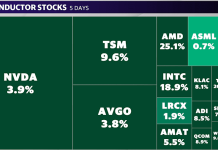
Here’s the kind of historical parallel that tends to separate informed investors from the crowd: Nvidia is doing exactly what RCA did in the 1920s.
RCA made the radios. It made the vacuum tubes — the semiconductor chips of their day. Then it moved into owning the content and programming. Nvidia makes the AI chips, owns the hardware infrastructure, and is now moving aggressively into the software stack and ecosystem. Same play, a century apart.
By mid-decade in the 1920s, nearly half of American households had a radio. By mid-decade in this one, AI will be embedded in most businesses and homes. The economic — and market — effect is expected to be comparable.
The $45 Trillion Nobody Is Watching
This is the piece of the puzzle most financial media isn’t covering — and it may be the most important.
Roughly $40–$45 trillion in personal and institutional savings is currently sitting in countries where depositors earn inadequate or even negative returns. Japan is the most extreme case, with savers effectively funding government debt at near-zero rates for decades.
The escape route is now open. Stablecoins — dollar-denominated digital assets — allow any saver, anywhere, to earn 4–6% yields in U.S. dollars. Tokenized gold offers similar returns. For the first time, a Japanese retiree or a German pensioner can exit their domestic banking system and move into a competitive, dollar-denominated asset.
An estimated $1 trillion per year is already beginning to make that move — into U.S. stablecoins and tokenized gold. The recently passed GENIUS Act has formalized a regulatory framework for stablecoins, effectively opening the floodgates further. The U.S. has built a mechanism to absorb the world’s idle savings. The mainstream hasn’t priced this in yet.
Gold and Silver Aren’t What You Think
Conventional wisdom says gold rises with inflation. But Salvani argues inflation is actually running below 2% in real terms — and gold is surging anyway. Why?
Because gold is no longer primarily an inflation hedge. It’s evolving into a monetary savings asset — something people hold the way they once held a bank deposit, now with a yield attached via tokenization. His targets: $15,000 for gold and $2,000 for silver within three years.
Central banks have been accumulating gold for years. But the bigger, newer development is individual savers in yield-starved countries discovering they can earn 5–6% on tokenized gold. When tens of trillions in savings start flowing toward an asset class, the price movement isn’t incremental — it’s transformational.
Yes, There Will Be a Correction — Here’s How to Think About It
Salvani isn’t predicting a smooth ride. A significant correction — around 20%, likely around 2027–2028 — is part of the forecast. It will probably feel a lot like 1929.
But consider the math: if you’re up 100% and then down 20%, you’re still up 60%. The correction matters. The trajectory matters more.
The most likely trigger? China. Its banking system is under far more pressure than official data suggests, capital is fleeing, and its export-driven model faces serious structural headwinds. Salvani sees the risk of a Chinese financial system shock as real and significantly underpriced by global markets.
Japan, by contrast, is expected to return to quantitative easing — painful, but manageable.
Where to Position Now
The inside view, distilled:
- Go long U.S. equities — particularly the Dow Jones and Russell 2000. Declining rates, capital inflows from tokenization, tax reform stimulus, and reshoring of foreign investment are all stacking in the same direction.
- Accumulate gold and silver — physical and tokenized. The window to buy before the monetary savings asset repricing takes hold won’t stay open forever.
- Short Japan — structural headwinds are significant, and forced QE resumption is a matter of when, not if.
- Avoid China entirely — no return profile justifies the current risk.
The investors who missed the early 1920s did so because they were focused on the wrong risks. The same trap is being set today. The 1920s had radio; we have AI. They had post-pandemic recovery; so do we. They had a capital formation boom; we have tokenization.
The pattern isn’t perfect — but it’s close enough that you don’t want to be on the wrong side of it.
Based on analysis by Joseph Salvani, originally published on JD Unfiltered. Full commentary and video analysis available at jd-unfiltered.ghost.io.