












Jerome Powell was clear: No beehives or terraced roof gardens. No new fountains or fancy marble. No special elevators or VIP dining rooms.
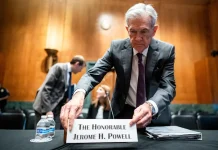
That is what the Federal Reserve chairman told Congress last June. Powell, during a hearing on monetary policy, was pressed by two Republican senators about cost overruns stemming from the ongoing renovations of two historic buildings, including the 88-year-old Marriner S. Eccles Building, the Fed’s pink-granite headquarters in Washington.
Now, Powell’s words are at the center of an extraordinary criminal investigation into the Fed chair. His critics have suggested that he may have lied during his testimony about the project, when he denied that luxury upgrades swelled its costs. Powell contends the investigation is a pretext to punish him for not cutting rates quickly enough.
The probe follows months of attacks by President Donald Trump, who has blasted Powell over the cost overruns and — more broadly — for not lowering interest rates.
“He’s billions of dollars over budget, so either he’s incompetent or he’s crooked,” Trump told reporters Tuesday as he departed the White House for an economic speech in Detroit. “I don’t know what he is, but he certainly doesn’t do a very good job.” The president — who initially nominated Powell to the Fed chair job in 2017 — has denied having any knowledge of the criminal investigation.
No charges have been filed against Powell, and the grand jury subpoenas issued to the Fed do not ensure an indictment will be returned.
A review of the Fed chair’s testimony, as well as public statements he has made about the project, show how Powell has responded to the various allegations of costly additions to the building.
Powell’s testimony focused mostly on inflation and interest rates. But lawmakers also grilled Powell about why the cost of the headquarters renovation project had ballooned by about a third to $2.5 billion from $1.9 billion.
‘Not Really Safe’
The Fed “has spent billions on lavish renovations to its DC offices,” Senator Tim Scott, the committee’s chair, said in his opening remarks that day.
“We’re talking about rooftop terraces, custom elevators that open into VIP dining rooms, white marble finishes and even a private art collection,” Scott said, adding that the Fed “hasn’t turned a profit since 2022.”
Senator Mike Rounds, a South Dakota Republican, also wanted answers. He told Powell that an explanation of the cost overruns was warranted because lawmakers were “talking about billions of dollars in costs.”
Powell testified that prior to becoming chair, when he was serving as administrative governor, he “came to understand how badly the Eccles building really needed a serious renovation” and had “never had one.”
“It was not really safe and it was not waterproof and that kind of thing,” Powell said.
Scrapped Water Features
Powell testified that media reports cited at the hearing were “inaccurate.” He said there was no VIP dining room, no new water features, no beehives and “no roof terrace gardens.” He also said there was no new marble other than where “some of the old marble broke.”
“I’m happy that there are no beehives in there, but we’re going to figure out what they are anyways,” Scott said.
The senator said the allegedly lavish renovation work was not only found in articles in the New York Post and the Wall Street Journal, as Powell suggested, but on the “final plans” found on National Capital Planning Commission’s website.
But Powell characterized some of the media reports as misleading, according to the transcript. He also pushed back on the claim about “special elevators.”
“It’s the same elevator — it’s been there since the building was built,” Powell said, “that’s a mischaracterization.“ He added some of those details are no longer in the plans, which “have continued to evolve.”
Scott asked if the changes were made starting in April, as a result of media attention on the cost overruns, “or was that just never in the plan?”
The Fed chairman said he would provide that information but maintained that the details being discussed were not the drivers for the cost overruns. The Fed later created a fact sheet and FAQ to answer questions about the controversy.
According to the Fed, the price tag for the renovation has more to do with the challenges of building — particularly underground — in what was once a swamp near the Tidal Basin along the Potomac River. The Fed also cited the cost of removing asbestos and lead and replacing antiquated mechanical systems.
Powell went into greater detail in a July letter to Office of Management and Budget Director Russell Vought, saying that earlier designs that called for new water features were scrapped in favor of renovating existing fountains, and that new VIP dining rooms were never called for.
“There are no VIP dining rooms being constructed as part of the project,” Powell said. “The Eccles Building has historic multi-use rooms on the 4th Floor that are used as conference rooms and for mealtime meetings. These rooms are being renovated and preserved.”
DOJ Referral
A few weeks after the Senate hearing, Republican Representative Anna Paulina Luna wrote to Attorney General Pam Bondi, saying Powell had omitted earlier renovation work in 1993 and 2003 from his testimony and calling for an investigation. She also pointed to the alleged luxury raised by Scott.
“If Chairman Powell knowingly misrepresented these facts — whether in testimony before Congress or in formal correspondence to senior executive officials — such actions may constitute perjury or materially false statements under federal law,” Luna wrote in her letter to Bondi.
Powell responded to that argument in his letter to Vought, saying, “While periodic work has been done to keep these buildings occupiable, neither building has seen a comprehensive renovation since they were first constructed.”
Mike Romano, a former federal prosecutor with the Justice Department’s Public Integrity Section, said the investigation into Powell is “highly unusual” without some indication that he was lying to lawmakers in an attempt to benefit himself.
Romano said an allegation of self-dealing or enrichment of friends could lead to a probe. “But going to Congress and testifying about why a construction project was needed, or how it was going, without some sense of a person lying for the sake of benefiting themselves, I struggle to think that that would be worth investigating,” he said.