


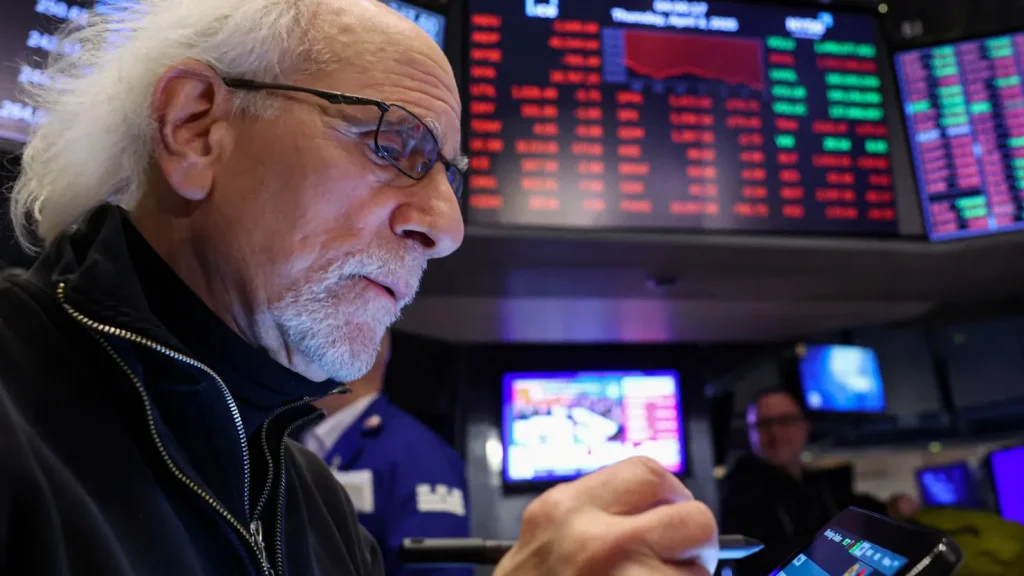
U.S. stock futures dropped on Sunday evening as the White House remained defiant even after a two-day historic stock market rout that followed President Donald Trump’s rollout of shockingly high tariff rates on most key U.S. trading partners.
Dow Jones Industrial average futures fell 979 points, or 2.5% Sunday evening, pointing to another brutal session ahead on Monday. S&P 500 futures shed 2.9%. Nasdaq-100 futures lost 3.9% as investors continued to shed their one-time tech winners to raise cash.
This follows a market wipeout to end last week:
- The Dow posted back-to-back losses of more than 1,500 points for the first time ever, including a 2,231-point shellacking on Friday.
- The S&P 500 dropped 6% on Friday for its worst performance since the outbreak of the pandemic in March 2020. The benchmark lost 10% in two days, pushing it to more than 17% below its February record, perilously close to a 20% bear market.
- The Nasdaq Composite entered a bear market Friday — down 22% from its record — after losses on Thursday and Friday of nearly 6% apiece.
Investors did not receive the news over the weekend they were wishing for that the Trump administration was having successful negotiations with countries to lower the rates, or at the very least, was considering delaying the set of so-called reciprocal tariffs due to take effect April 9. The initial unilateral 10% tariff went into effect Saturday.
Instead the president and his key advisors played down the sell-off:
- Trump said Sunday evening on the market sell-off: “I don’t want anything to go down, but sometimes you have to take medicine to fix something.”
- Trump added, “We have a trillion-dollar trade deficit with China, hundreds of billions of dollars a year we lose with China. And unless we solve that problem, I’m not going to make a deal.”
- Commerce Secretary Howard Lutnick told CBS News that the tariffs would not be postponed. “The tariffs are coming… They are definitely going to stay in place for days and weeks.”
- Treasury Secretary Scott Bessent noted to NBC News that more than 50 countries have approached the administration for negotiations, but cautioned “they’ve been bad actors for a long time, and it’s not the kind of thing you can negotiate away in days or weeks.”
Investors were surprised first by the magnitude of certain rates applied to trading partners that appeared to be based on a formula without a valid rationale based on established economic theory. They were rattled further when China on Friday decided to retaliate first with a 34% tariff on all U.S. imports, instead of negotiating.
“Trump’s Liberation Day last Wednesday triggered annihilation days on Thursday and Friday, with the stock market vigilantes giving a costly thumbs-down to Trump’s reign of tariffs,” wrote Ed Yardeni, president and chief investment strategist of Yardeni Research, in a note to clients Sunday.
While the administration said at least 50 nations had reached out to start negotiations, Canada and the European Union were planning to follow China’s lead and readying retaliatory tariffs against the U.S. Vietnam has offered already to cut tariffs on the U.S. to zero, according to Trump, but they appeared to be the exception so far.
Fears grew on Wall Street that the sell-off would feed on itself with hedge funds forced to sell down equities and other risky assets to raise cash and meet margin calls. The CBOE Volatility Index, Wall Street’s fear gauge, closed Friday at the 45 level, an extreme level seen mostly only during bear markets.
“Margin calls are going out as we speak,” said Chris Rupkey chief economist at FWDBONDS. “For a third straight day investors in U.S. equity markets have turned (a) huge thumbs down on the White House Liberation Day tariffs which have rocked Wall Street.”
The price of bitcoin, which usually trades like another big tech stock but had bucked the broader market meltdown last week, fell under the $80,000 Sunday in another sign of de-risking on Wall Street.
Global markets tumbled as they opened staring with Asia. Japan’s Nikkei 225 plunged 8%.